

Microsoft clearly generates cash.
A lot of it.
The real question is whether the cash flow we see today is still as clean as it looks, because Microsoft is no longer just an asset-light software compounder.
It is becoming something heavier.
More cloud infrastructure.
More AI capex.
More data centers.
More finance leases.
More long-term obligations.
And that changes the way cash flow needs to be read.
Reported operating cash flow rose from $76.7 billion in FY2021 to $136.2 billion in FY2025.
That is exceptional.
Revenue rose from $168.1 billion to $281.7 billion over the same period, while reported free cash flow stayed strongly positive every single year.
So on the surface, the story is simple:
Microsoft is still one of the strongest cash-flow machines in the world.
But below the surface, the story is more nuanced.
Because reported free cash flow currently looks better than economic free cash flow.
And that difference matters.
Cash flow is still strong, but the business is changing
From FY2021 to FY2025, Microsoft’s operating cash flow expanded massively.
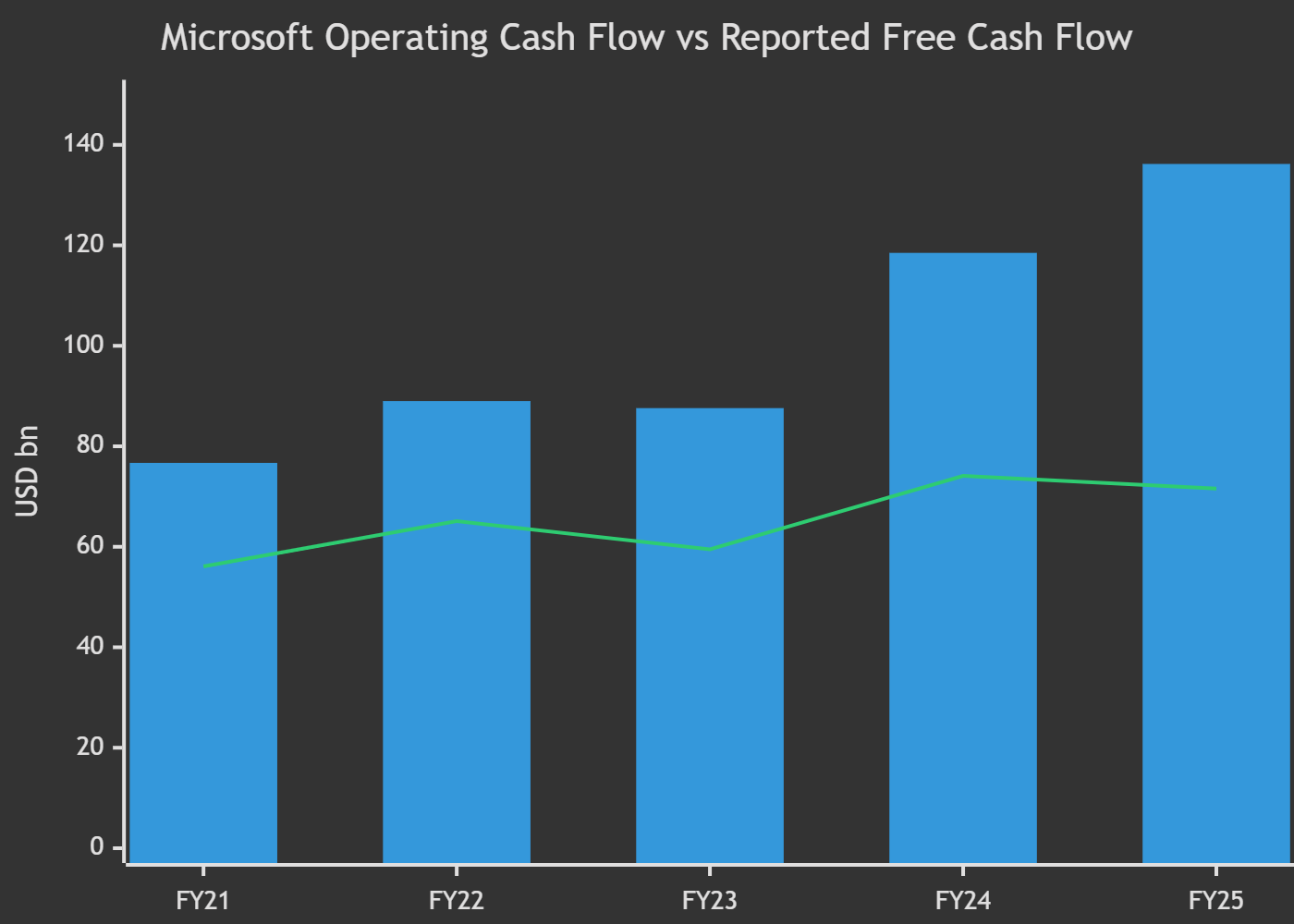
The operating engine is not the problem.
If anything, the operating engine is getting stronger.
The issue is what happens after operating cash flow.
Because capex moved from $20.6 billion in FY2021 to $64.6 billion in FY2025.
That is a huge change.
Microsoft is still producing enormous free cash flow, but more of that cash is now being reinvested into cloud and AI infrastructure.
That means the company is no longer only monetizing software.
It is also funding a very large physical infrastructure cycle.
This is the key shift.
The AI capex problem
The market wants Microsoft to grow through AI.
But AI is not free.
It needs:
☁️ data centers
⚙️ GPUs and CPUs
🔌 power capacity
🏗️ construction commitments
📄 finance leases
🧠 long-term infrastructure commitments
This is why the reported FCF number needs context.
For the first nine months of FY2026, Microsoft reported about $127.5 billion of operating cash flow and roughly $80.1 billion of cash capex, implying reported FCF of about $47.3 billion.
But management’s capex disclosures including finance leases were much higher, around $104.3 billion over the same nine-month period.
So the more economic version of free cash flow is closer to $23.2 billion, not $47.3 billion.
That does not mean Microsoft has bad cash flow.
It means the reported cash flow statement does not fully capture the current AI infrastructure burden in the same period.
And for a cash-flow deep dive, that is exactly the kind of thing that matters.
The balance sheet is still strong
This is the other side of the story.
Even after acquisitions, cloud buildout, AI investments, dividends, and buybacks, Microsoft remains net-cash positive.
At FY2025 year-end, Microsoft had about $94.6 billion in cash and short-term investments against about $43.2 billion of debt.
In the latest available quarter, the company still had roughly $78.3 billion in cash and short-term investments against about $40.3 billion of debt.
So this is not a company stretching itself.
It is a company choosing to reinvest aggressively from a position of strength.
That difference is important.
Weak companies invest because they have to.
Microsoft is investing because it can.
The cash-flow quality is still high
Microsoft’s cash-flow quality remains excellent because the business is built on recurring revenue, enterprise software, cloud contracts, deferred revenue, and long-term performance obligations.
This is not a one-product cycle.
It is a platform.
Microsoft 365, Azure, GitHub, LinkedIn, Dynamics, Windows, gaming, security, AI infrastructure — all of these create a broad base of monetization.
That is why operating cash flow keeps expanding.
But the current cycle has a clear question attached to it:
will AI monetization eventually catch up with AI infrastructure spending?
That is the question that matters more than almost anything else in the stock right now.
What we go deeper into below
The free section shows the main picture: Microsoft is still an exceptional cash-flow business, but the cash-flow profile is changing because AI infrastructure is making the company more capital-intensive.
The deeper question is valuation.
Below, I go through the DCF model, the assumptions behind the cash-flow forecast, the fair-value range, and the difference between reported FCF and economic FCF.
Because Microsoft is not hard to admire.
The hard part is deciding what price makes sense.
At today’s price, the market is not simply paying for Microsoft’s current cash flow.
It is paying for the belief that today’s AI capex will become tomorrow’s higher-margin cash flow.
That is the real debate.